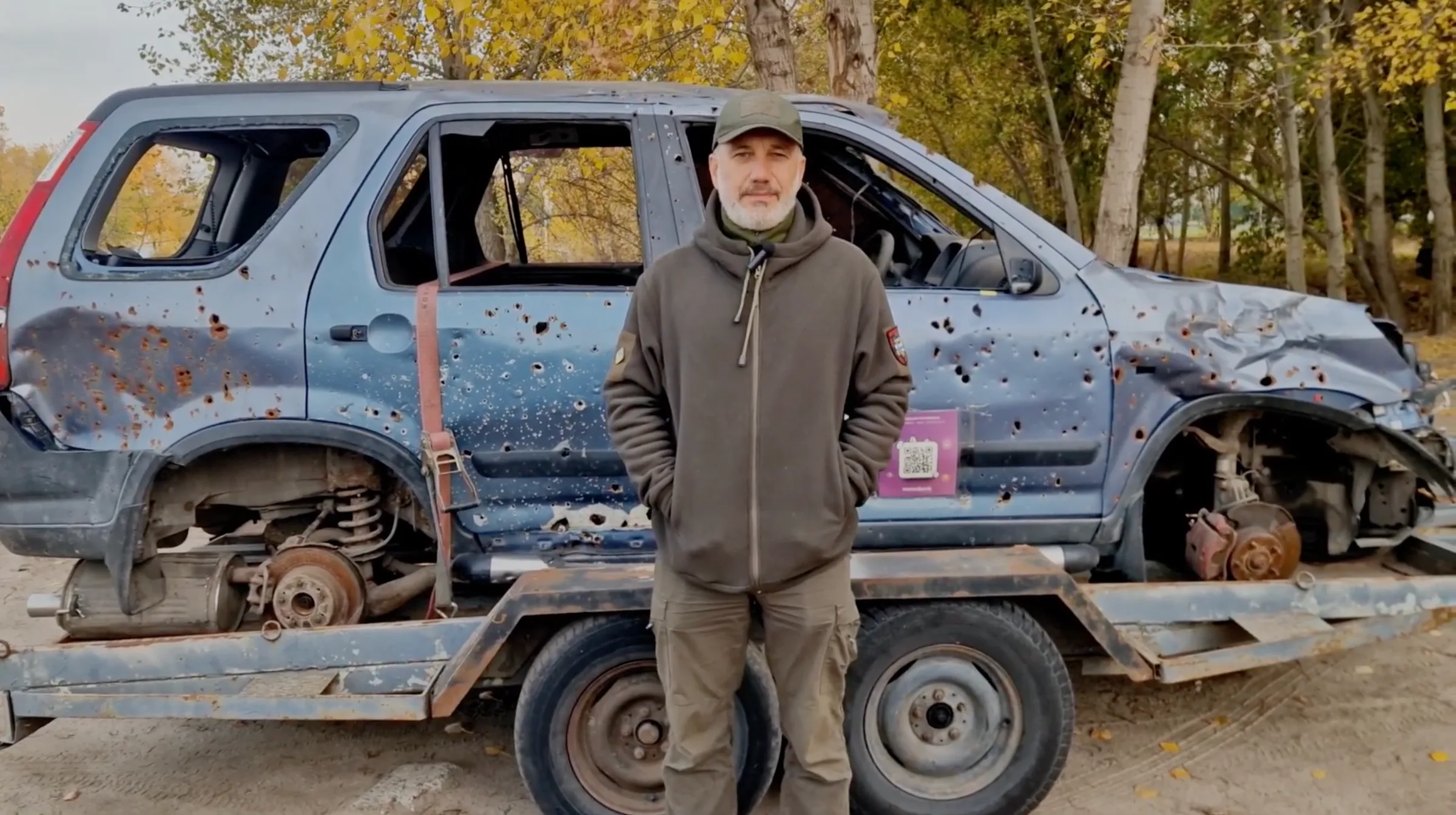
Rebuilding Ukraine: $588 billion, and the question no one is answering
$588 billion over ten years. Three times Ukraine's GDP. The total cost of rebuilding the country, after four years of war, has now been calculated. The real question is still open: who is going to pay?
Every winter, Ukraine runs the same calculation. How many power plants are still standing. How many transformers must be replaced. How many schools to reopen. How many hospitals to repair. How many billions lost in the night, under ballistic missiles and Shahed drones.
In February 2026, in Kyiv, the World Bank, the Ukrainian government, the European Commission and the United Nations released their fifth joint damage assessment — the RDNA5. A 200-page document that turns a war into figures.
The most striking one: $588 billion.
That is what will need to be mobilized over the next ten years to put Ukraine back on its feet. Roughly three times its 2025 GDP. The equivalent of France's annual budget. More than the Marshall Plan (which cost about €175 billion in today's money). Probably the largest reconstruction effort in Europe since 1945.
And behind that figure, an even harder political question: who is going to pay?
The scale of the damage
To understand the challenge, look first at what has been destroyed.
The RDNA5 distinguishes three main categories: direct damage (what has been physically destroyed), economic losses (what has not been produced because of the war), and reconstruction needs (what must be invested to rebuild better).
| Indicator | Amount (end of 2025) |
|---|---|
| Cumulative direct damage | $195 billion |
| Cumulative socio-economic losses | $667 billion |
| 10-year reconstruction needs | $588 billion |
| Increase in needs in one year | + 12.2 % (+$64 billion) |
| Damage in 2025 alone | $64 billion |
| Residential buildings damaged or destroyed | about 14 % of the national stock |
| Internally displaced persons (IDPs) | about 4.5 million |
The RDNA5 also notes that at least $20 billion has already been invested since February 2022 in urgent repairs — roofs, schools, hospitals, bridges.
Three sectors account for most of the needs:
Logistics (roads, bridges, railways, ports) tops the list. Then energy — a priority target of Russian strikes since the winter of 2022, with a record intensification in late 2025. Then housing: more than 132,000 residential buildings have suffered major damage, forcing 4.5 million people to relocate inside the country.
And one figure rarely cited: $28 billion for demining and the management of explosives alone. Ukraine is now the most heavily mined country in the world, ahead of Cambodia and Yemen.
The uncomfortable question: who pays?
This is where the question becomes political. And complex.
The Ukrainian government cannot, by far, finance a project of this scale alone. In 2026, the Ukrainian state has budgeted $15.25 billion for reconstruction, of which only 34 % has been secured through the national budget and international partners. The rest is pending.
Four major sources of funding exist. All are necessary. None is sufficient.
1. The European Union — the main pillar
The EU created in 2024 its Ukraine Facility, a financial mechanism worth €50 billion over 2024-2027, combining loans (€33 billion) and grants (more than €5 billion). Added to this are €9.5 billion in guarantees intended to mobilize €40 billion in private investment.
The Ukraine Investment Framework, which coordinates EU / EIB / EBRD / World Bank financing, has already committed €8.4 billion to mobilize €25.2 billion in additional investment. And a new €1.5 billion investment plan was unveiled in March 2026.
In total, the EU and its member states have mobilized close to €134 billion for Ukraine since 2022 — across all categories (military aid, humanitarian, budget support, reconstruction).
2. International financial institutions
The European Bank for Reconstruction and Development (EBRD) has deployed €9.7 billion since 2022 and increased its capital by €4 billion. The European Investment Bank (EIB) finances €7.3 billion in municipal, energy and transport projects. The World Bank, through its URTF (Ukraine Recovery Trust Fund), channels grants for emergency projects.
3. Bilateral states
Many countries operate outside the EU. The United States, under the Trump administration, signed in April 2025 an agreement creating a US-Ukraine Reconstruction Investment Fund managed by the Development Finance Corporation — with a target of about $200 million in actual investments by the end of 2026. The amount is far below European commitments, but the American interest lies elsewhere: Ukraine's mineral wealth (rare earths, lithium, titanium) is part of the negotiated counterpart.
The United Kingdom has committed £5 billion since 2022, including £4.1 billion in guarantees (through the World Bank) and £20 million in the MIGA investment-insurance trust fund.
4. The private sector
This is probably the great unknown. According to the RDNA5, up to 40 % of reconstruction needs could be financed by private investment over the next ten years. Provided that the promised reforms (rule of law, anti-corruption, openness to investors) are actually delivered.
The shift has begun. Ukrainian private groups (DTEK, Ukrhydroenergo, Metinvest) are launching flagship projects. Western multinationals are positioning themselves: Bechtel (US) has signed a memorandum to plan logistics corridors. Vestas (Denmark) is supplying 83 turbines to DTEK for the Tyligulska wind farm (€450 million). Schneider Electric (France) is reinforcing the electrical grid with batteries.
But many investors are waiting. Russian attacks continue. And the question of legal stability remains open.
Russian assets: 300 billion in limbo
Beyond these classic flows, the central reconstruction issue lies elsewhere: in the Russian assets frozen in the West.
Since February 2022, about €300 billion of the Russian Central Bank's assets have been immobilized in Western countries. The bulk — about €185 billion — sits in Belgium, at Euroclear, the international securities depository. The rest is scattered across France, Germany, the United Kingdom, Japan and several other jurisdictions.
For three years, the West hesitated. Confiscating these assets and transferring them to Ukraine would solve a large part of the financing problem. But it would set a major legal precedent, and risk destabilizing financial markets by driving away foreign holders of reserves in Western economies.
A middle way was eventually found. In June 2024, at the G7 summit in Italy, the “Group of Seven” announced an exceptional $50 billion loan to Ukraine — backed not by the assets themselves, but by the interest these frozen assets generate each year (€2.5 to €3 billion annually).
The mechanism is called ERA (Extraordinary Revenue Acceleration). The first tranche of €3 billion was paid out by the EU in January 2025. The total European share of the loan amounts to €18.1 billion. For Volodymyr Zelensky, this mechanism is insufficient. He continues to call for the outright confiscation of the €300 billion.
“It is only fair that Russia should pay.” — Volodymyr Zelensky, G7 summit, June 2024
The debate remains open. Several European states, including France and Germany, oppose outright confiscation, fearing the legal and financial consequences. Others — the United Kingdom, Canada and several Baltic states — are more in favour. Belgium, the country where most of the assets are held, plays a pivotal role in the decision.
The actors on the ground
On the Ukrainian side, coordination is run by the State Agency for Restoration and Infrastructure Development, created in 2023 and headed by Deputy Prime Minister Oleksii Kuleba. It centralizes projects, manages public procurement through the Prozorro platform (an online tendering system), and works with international donors.
The Agency has already identified 21 priority projects for 2026, ranging from the restoration of medical and educational facilities to the modernization of municipal infrastructure in three oblasts.
On the private side, several large Ukrainian groups are positioning themselves as prime contractors:
| Group | Sector | Flagship project |
|---|---|---|
| DTEK (Rinat Akhmetov) | Energy | Tyligulska wind farm — 500 MW, €450M |
| Ukrhydroenergo | Hydropower | Reconstruction of damaged dams |
| Ukrnafta | Energy | Gas turbines, €160M EBRD loan |
| Metinvest | Steel | Steel-industry reconstruction |
| Naftogaz | Gas | Underground storage and grid |
| Ukravtodor | Roads | National road network |
Contracts with international consortia are multiplying. Beyond the firms mentioned above (Bechtel, Vestas, Schneider, GE Vernova), Turkish and Polish groups are heavily present in construction. French groups (Vinci, Bouygues) are watching more than they are investing, by caution.
Corruption, the blind spot we cannot ignore
It would be dishonest to discuss the Ukrainian reconstruction without addressing the elephant in the room.
Ukraine has made considerable progress since the 2014 revolution: creation of the National Anti-Corruption Bureau (NABU) in 2014, the Specialized Anti-Corruption Prosecutor's Office (SAPO) in 2015, and the High Anti-Corruption Court in 2019. The public-procurement platform Prozorro has become an international reference for transparency. In the first half of 2025 alone, the NABU opened 370 new investigations and identified 115 suspects.
But this infrastructure remains fragile. And 2025 demonstrated it spectacularly.
July 2025: the takeover attempt
On 22 July 2025, the Ukrainian Parliament passed a law placing the NABU and SAPO under the control of the Prosecutor General — who is appointed by the President. The text gave the latter the power to reassign cases, give binding instructions to anti-corruption prosecutors, and even remove politically sensitive cases from NABU jurisdiction.
President Zelensky signed the law the same day.
The reaction was immediate. The first major demonstrations since the start of Russia's invasion. Tens of thousands of people in the streets of Kyiv, Lviv, Dnipro, Kharkiv. Slogans of “Hands off NABU/SAPO.” The European Union called the law a “serious setback.” The G7 ambassadors expressed “deep concern.” The OECD warned of consequences for foreign investment.
On 31 July, Parliament repealed its own law. A victory for Ukrainian civil society. But the tensions did not disappear.
November 2025: Operation Midas
Three months later, on 10 November 2025, the NABU revealed the results of a fifteen-month investigation codenamed “Operation Midas.” The scandal was massive.
At the heart of the scheme: Energoatom, the state-owned company operating Ukraine's nuclear power plants — about 60 % of national electricity production. According to investigators, two people installed inside Energoatom — Ihor Myroniuk (a former adviser to the Energy Minister) and Dmytro Basov (a former prosecutor) — controlled all contracts with suppliers. The mechanism: a 10-15 % kickback on every contract. Any supplier who refused risked never being paid.
Total siphoned: at least $100 million. At least.
Three names emerge. Timur Mindich — a former associate of Volodymyr Zelensky in the Kvartal-95 production company before his election — appears as the organizer. Herman Halushchenko, Energy Minister from 2021 to 2025 and Justice Minister since July 2025, is cited in the recordings as having provided “political cover.” Oleksiy Chernyshov, former deputy prime minister, has been indicted for illicit enrichment in a related case.
Mindich and his business partner Oleksandr Tsukerman left the country before the searches. Five other people were arrested.
The European Union quickly responded: the fight against corruption is now an explicit condition for Ukrainian accession and for unlocking future reconstruction funding.

The real risks
Beyond the Energoatom scandal, several systemic risks weigh on the reconstruction project.
1. Capture by oligarchs. Ukraine remains dominated by a few large business groups, often tied to political interests. The risk that reconstruction benefits these conglomerates more than the local population is documented by several NGOs, including Transparency International Ukraine.
2. Greenwashing. Under Western pressure, many reconstruction projects are labelled “green” or “sustainable.” But oversight remains weak. The risk that projects are funded under environmental labels without delivering real benefits is real.
3. Donor dependency. The more Ukraine depends on external financing for its reconstruction, the more it loses political autonomy. Some of the conditions imposed (economic reforms, openness to foreign investors, alignment with the EU acquis) are consistent with Ukrainian ambitions. Others risk generating frustration.
4. Accumulated debt. Much of the reconstruction financing takes the form of loans — not grants. Out of the G7's $50 billion, the EU Ukraine Facility's €33 billion, the multiple multilateral envelopes. All will have to be repaid. Ukrainian public debt has risen from 50 % of GDP in 2021 to more than 100 % of GDP in 2025. The ratchet effect is setting in.
5. Persistent insecurity. As long as the war is not over, every rebuilt power station is a potential target. Every restored bridge can be destroyed again. Russian attacks on energy infrastructure have more than doubled between the winter of 2024 and the winter of 2025.
A blurred political horizon
By the end of April 2026, the political horizon for reconstruction remains uncertain.
The 28-point Trump plan, presented in December 2025 to the Ukrainian government, proposes a ceasefire based on territorial concessions. It was rejected as such by Kyiv, but a negotiation is open. Depending on the terms of any future agreement, reconstruction conditions could vary considerably.
Several scenarios are on the table:
- Sustained ceasefire, frozen borders: reconstruction can begin in zones held by Kyiv, Western aid stays massive, EU accession progresses
- Frozen conflict without formal agreement: financing continues but slows, legal uncertainty drives away part of the private investment
- Resumption of hostilities: reconstruction is paused, funds redirected to military
- Comprehensive peace agreement with territory returns: complete change in the scale of needs, redefinition of priorities
The RDNA5, by construction, takes no position on these hypotheses. It quantifies needs based on documented damage.
The real question
In the end, the issue is probably not just “who pays?”. It is “who decides how?”.
The $588 billion will not be spent in five years. Nor in ten. Probably in twenty or thirty. Over that span, Ukraine's institutional fabric will deeply change. The generations that will rebuild the country are teenagers today. The country that emerges from the war — whenever it does — will look like neither the one before 2022, nor the one international donors imagine today.
This is probably the great difference with the Marshall Plan to which Ukrainian reconstruction is often compared. The Marshall Plan was a coherent architecture, led by the United States alone, in countries that had retained their industrial capacities. Here we are talking about a patchwork of dozens of donors, with sometimes contradictory conditions, and a country part of whose territory remains under military occupation.
Ukraine will be rebuilt. Few doubt that. But it will be rebuilt slowly. With compromises. And probably keeping for a long time the scars of today.
That is precisely what the raw figures don't say. And that is precisely why we have to keep looking at them.
Main sources
- World Bank — Updated Ukraine Recovery and Reconstruction Needs Assessment (RDNA5), 23 February 2026
- UN News — Ukraine: $588 billion recovery cost over the next 10 years
- Cabinet of Ministers of Ukraine — Official RDNA5 presentation
- European Commission — Ukraine Facility 2024-2027
- European Commission — First tranche of the ERA loan disbursed, 10 January 2025
- G7 / White House — 50 billion loan backed by frozen Russian assets
- National Anti-Corruption Bureau of Ukraine (NABU)
- Brookings Institution — War, peace, and corruption in embattled Ukraine, December 2025
- Human Rights Watch — Ukraine: New Law Undermines Anti-Corruption Bodies, July 2025
- EBRD — Activities in Ukraine
- EIB — Statement on priority infrastructure projects, April 2026
- Ukraine Donor Platform
- Transparency International Ukraine
This article will be updated as the political and financial dynamics of the reconstruction evolve. If you work in this sector — donor, NGO, contractor, local journalist — and would like to share testimony or data with us, please write to hello@kero.media.