The $500 Drone Rewriting Modern Warfare
Cost asymmetry, fiber optics, mothership drones, ground robots, Mexican cartels: an investigation into the low-cost weapon redrawing modern conflicts — and driving up the civilian death toll.
A US Patriot surface-to-air missile costs roughly $4 million apiece. An Iranian Shahed drone, manufactured under license by Russia as the Geran-2, is estimated at $20,000 to $50,000. A standard Ukrainian FPV drone — those armed, jury-rigged racing drones that now infest the front line — comes out to $2,000, batteries included. A logistics ground robot: under $20,000. A single autonomous mothership-drone mission, AI-guided and capable of striking 300 km away: $10,000 — the price of a used car.
The math is simple. And it is precisely that simplicity that is changing warfare.
An Unprecedented Asymmetry
For the first time in modern military history, the weapon doing the striking costs less than the munition trying to stop it. This economic inversion isn't a technical footnote — it's a strategic earthquake. It means a poor state can saturate a rich state's defenses; a non-state actor can hit critical military infrastructure; a single soldier can destroy a $4 million tank with a contraption assembled from spare parts.
Ukraine contracted roughly 4.5 million FPV drones in 2025. Its defense ministry says it delivered one million FPVs between January and July 2025, and hit 820,000 Russian targets that year through its Army of Drones Bonus program — a system that pays units according to their documented strikes. According to Ukrainian minister Mykhailo Fedorov, drones now account for nearly 80% of damage inflicted on the front line.
These are no longer special operations. This is industry.
Four Families, One Mutation
The word drone covers, in the press, devices that have almost nothing in common. To make sense of what's happening, one has to distinguish.
- The consumer quadcopter (DJI Mini 4 Pro, $759). Originally for photography, tourism, inspection. Repurposed within hours to drop grenades.
- The professional quadcopter (DJI Matrice 30T, around $10,000). Designed for civil security, industrial inspection, mapping. Used at the front for reconnaissance and artillery spotting.
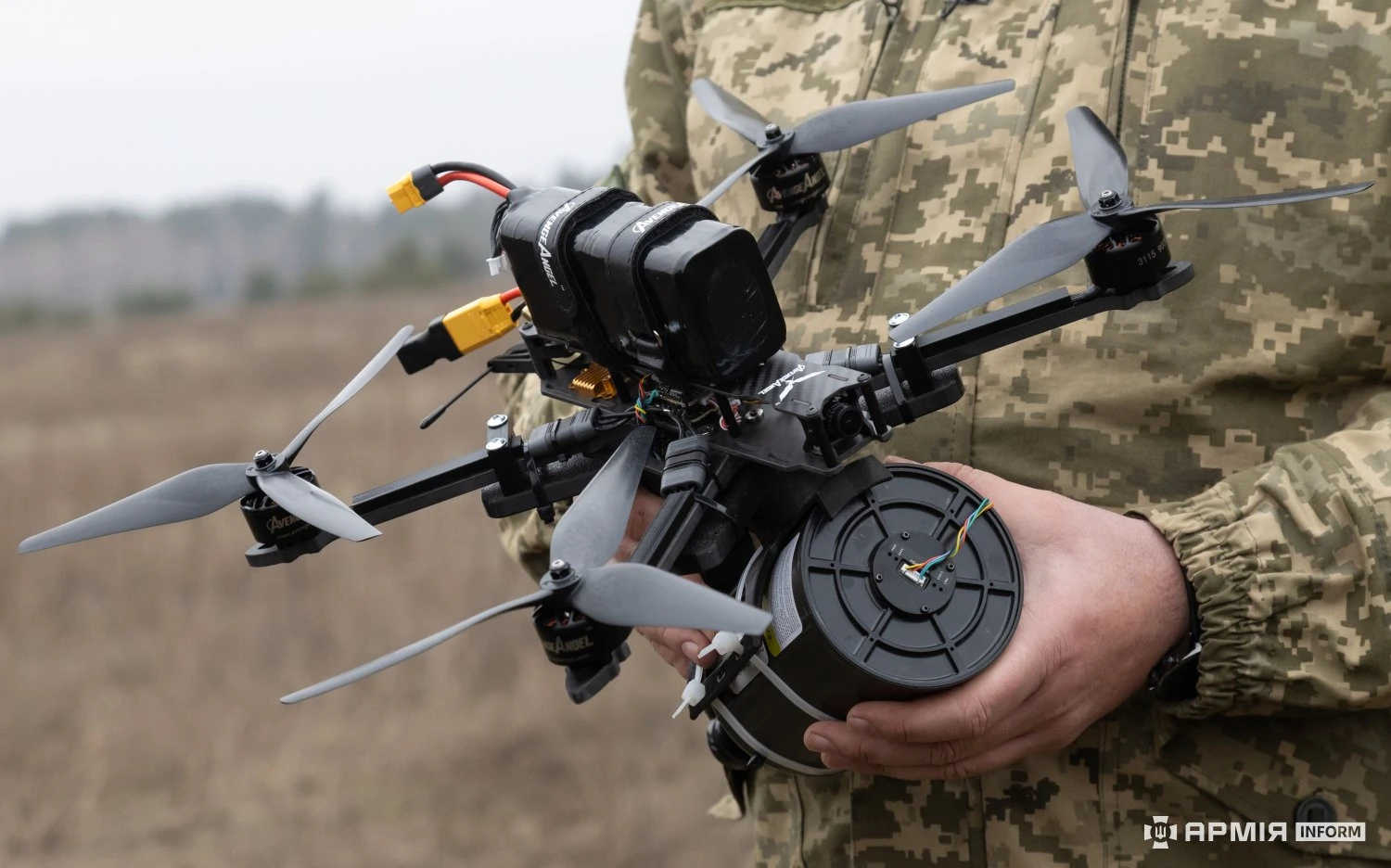
- The combat FPV (around $2,000). First-person-view piloting through video goggles, integrated explosive payload, range of 10–20 km. The dominant weapon of the war in Ukraine.
- The loitering munition (US Switchblade 300, Israeli IAI Harpy). A single-use missile-drone, capable of circling its target before diving in. From $20,000 to several hundred thousand, depending on range and payload.
Between the $759 Mini 4 Pro and the multi-million-dollar Bayraktar TB2, every price point exists. And every one of them, now, can kill.
Fiber Optics: The Silent Revolution of 2025
For two years, the drone war was also a war of radio waves. Every FPV drone had its corresponding jammer. Every jammer, a new frequency. This exhausting race tipped in favor of the defenders during the winter of 2024: "classic" radio-controlled FPVs saw their effectiveness collapse as Russian and Ukrainian units saturated the electromagnetic spectrum.
Then came the fiber-optic drones.
The principle is disarmingly simple: replace the radio link with a fiber-optic cable several kilometers long, unspooled in flight from an onboard reel. No signal to jam. No frequency to intercept. No emissions to detect. The drone becomes invisible to electromagnetic sensors and immune to electronic warfare.
Mass-deployed by Russia in spring 2024 and immediately copied by Ukraine, these systems shifted the tactical balance in months. Standard reels are 5 to 20 kilometers long. In October 2025, the Ukrainian firm Ptashka Systems announced a test flight of 47 kilometers — limited not by the fiber, but by the batteries.
The cost? Higher than a standard FPV, but trivial compared to the electronic countermeasures it renders obsolete. And the most striking thing isn't the device itself — it's what it leaves behind.
Aerial footage shot by civilian drones over the fields of the Pokrovsk region, in eastern Ukraine, now shows carpets of fiber-optic cable stretched across square kilometers. Tens of thousands of threads, individually fragile but collectively indestructible, snare in vegetation, catch on farm equipment, strangle wildlife. A silent, lasting pollution that no one yet knows how to handle — assuming it can be handled at all.
A new environmental debt of war. Added to the mines.

The Robots Land on the Ground
The other revolution of 2025–2026 doesn't fly. It rolls.
Unmanned Ground Vehicles — UGVs — were still considered prototypes two years ago. In April 2026, Ukrainian minister Mykhailo Fedorov announced an order for 25,000 UGVs for the first half of 2026, more than double the volume contracted in 2025. In March 2026 alone, the Ukrainian army carried out 9,000 missions using ground robots.
Their uses, in order of frequency:
- Logistics (80% of missions, according to several units). Delivering ammunition, food, water, replacement drones to front-line trenches. The "kill zones" — areas where any human silhouette is tracked and struck by a drone — have made traditional human logistics impossible.
- Medical evacuation. Platform robots carry wounded soldiers across kilometers where an ambulance would be shot down within minutes. The commander of one Ukrainian battalion explains that his UGV pilots "watch the intercepted video feeds of Russian drones to check whether they themselves are being hunted."
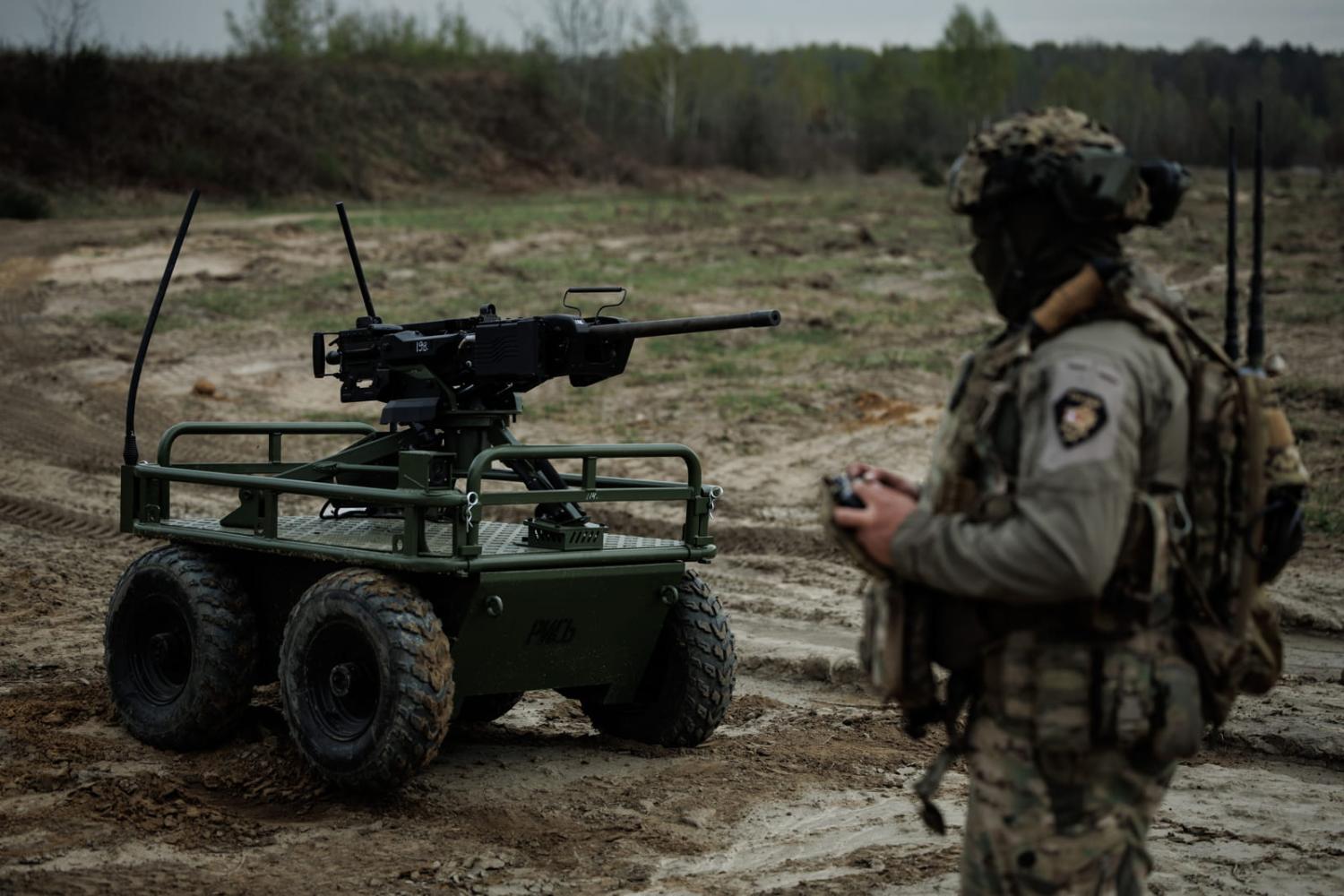
- Combat. Remote-operated machine guns, mine-laying, suicide robots packed with explosives sent against Russian positions. In June 2025, Volodymyr Zelensky announced that Ukrainian soldiers had captured a Russian position using nothing but unmanned platforms — a first in military history.
Ukrainian models bear names that announce their function: Termit (300 kg payload), Murakha (500 kg, 100 km range), Liut (7.62 mm machine gun, day-and-night operations), NUMO (modular tracked platform), UNEX (amphibious, capable of rolling over ice, swamps, or even ceramic tableware without breaking it). Average cost: under $20,000 per unit.
The Ukrainian defense ministry's stated objective is unambiguous: "100% of front-line logistics must be carried out by robotic systems." The logic is grim but clear: Ukraine recruits 25,000 to 27,000 soldiers a month, against 40,000 to 45,000 on the Russian side. The robots are there to fill the demographic gap.
The Black Sea: The Phantom Theater
While the world watched the land front, a naval revolution unfolded almost in silence.
In 2022, Russia's Black Sea Fleet was among the most powerful in the world. Its main base, Sevastopol, had housed the strategic core of the Russian navy in the Mediterranean since the days of Catherine the Great. Ukraine, on its side, had no real navy to speak of.
Three years later, the balance has flipped.
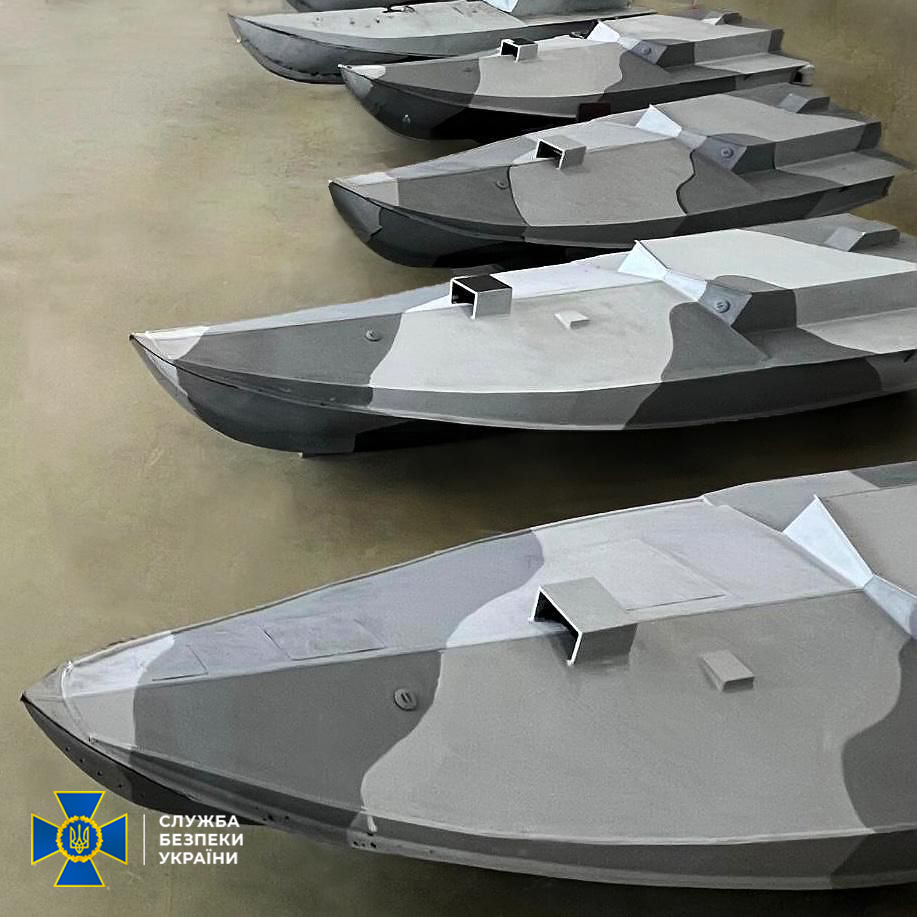
With its surface drones — Magura V5 and Sea Baby, motorized craft a few meters long, remote-piloted, packed with several hundred kilograms of explosives — Ukraine has sunk or damaged at least eleven Russian vessels, including frigates and missile carriers. Russia has done what was once unthinkable: it moved its main naval base from Sevastopol to Novorossiysk, on the Russian mainland.
In October 2025, a new generation of Sea Baby was unveiled. Range increased from 1,000 to 1,500 km. Payload up to 2 tonnes. AI-assisted targeting. The ability to launch small aerial drones of their own. Multi-layered self-destruct systems to prevent capture.
For the first time in recent military history, a state with no warships has achieved naval supremacy in a closed sea. No destroyers. No frigates. With craft the size of jet skis.
Mothership Drones, or the End of Range
If fiber optics canceled jamming, the next innovation canceled distance.
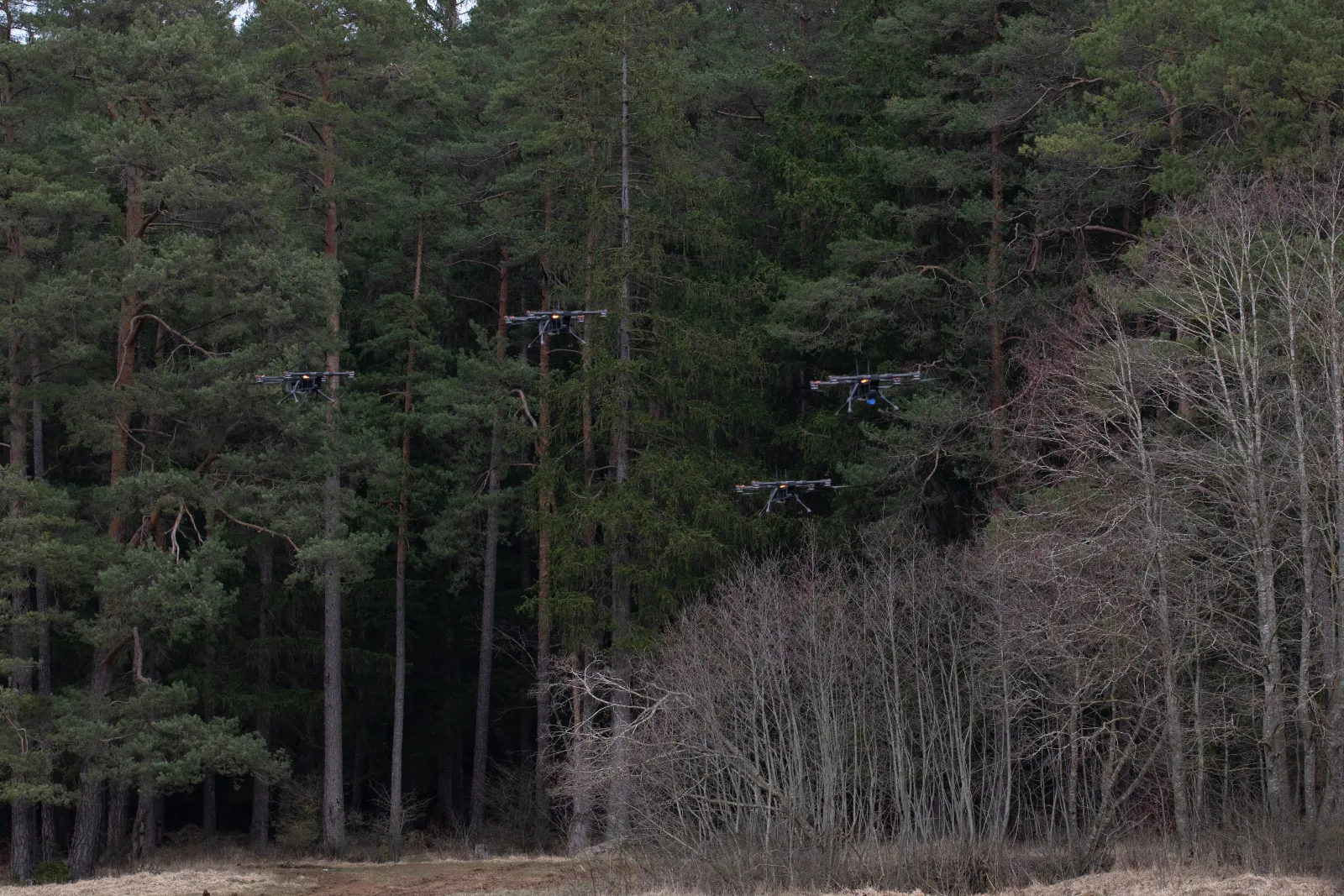
In May 2025, the Ukrainian startup Strategy Force Solutions deployed its GOGOL-M system in operational missions for the first time: an AI-piloted mothership drone that carries two FPV drones 300 kilometers behind enemy lines, releases them on their target, and returns alone to base. The released FPVs are themselves autonomous: they identify their targets and strike without a pilot, without GPS, using a visual navigation system named SmartPilot — comparable, according to its designers, to "a self-driving car with almost no obstacles ahead of it."
The cost of one mission? $10,000 for two strikes. To be compared with the $3 to 5 million of an equivalent cruise missile.
Russia copied immediately. Its Molniya mothership now extends the range of Russian FPVs tens of kilometers behind Ukrainian lines. More remarkable still: Ukrainian forces recently intercepted a modified Shahed-136, transformed into a mothership, carrying two FPVs under its wings. A craft designed to fly hundreds of kilometers autonomously, repurposed as a carrier for shorter-range tactical munitions. A fusion of strategic and tactical strike never seen before.
And Ukraine has already taken the next step: its surface drones now launch aerial FPVs. An autonomous naval drone carrying an autonomous aerial drone striking a target identified by AI. Three layers of autonomy in a chain. The human, somewhere far behind, validates the launch. For everything else — navigation, target selection, engagement — the machine decides.
Spiderweb: The Day the Rear Disappeared
June 1, 2025 will remain in military history as the day the very concept of "strategic depth" died.
That day, Ukraine launched Operation Spiderweb. For eighteen months, Ukrainian secret services (SBU) had infiltrated miniature FPV drones hidden in the cabins of trucks — ordinary cargo trucks — that traveled across all of Russia in convoy, parking near four air bases located more than 4,000 kilometers from the Ukrainian front line, some beyond the Urals, in Siberia.
On signal, the cabin roofs opened. More than a hundred FPVs lifted off simultaneously. Targets: Russia's strategic bombers — Tu-22M3, Tu-95, and even the A-50 radar planes, irreplaceable assets of Russian aviation, each worth several hundred million dollars.
Claimed result: at least a dozen strategic aircraft destroyed or damaged. Total cost on the Ukrainian side: a few hundred thousand dollars.
The operation was celebrated as a feat. But it sent a signal no government has yet absorbed: no military base, no refinery, no critical infrastructure is, in principle, beyond the reach of a determined actor with a few thousand dollars and a little time.
And what is true for the military is just as true for civilians.
Civilians, the First Victims
The most chilling figures don't come from the armies. They come from the United Nations.
The UN Human Rights Monitoring Mission in Ukraine documented, between February 2022 and April 2025:
- 395 civilians killed by short-range drones
- 2,635 civilians wounded by the same devices
For 2025 alone, the toll explodes:
- 577 dead
- 3,288 wounded
A 120% increase in a single year. In March 2026, the UN still identified short-range drones as the weapon that caused the most civilian casualties of the month — ahead of missiles, artillery, and mines.
UN investigators use a chilling word in their reports: "hunts." The drone operator, sometimes positioned ten or fifteen kilometers away, follows the target — a cyclist, a family on foot, an ambulance — for several minutes before striking. The drone descends slowly. The camera films everything. The footage often ends up on Telegram.
Sudan: The Other Laboratory
While all eyes are on Ukraine, another drone war is killing — more quietly, and possibly faster.
In Sudan, the Sudanese Armed Forces (SAF) and the Rapid Support Forces (RSF) have been fighting since 2023 a war in which drones occupy a central place. According to the UN Office of the High Commissioner for Human Rights, more than 500 civilians were killed by drone strikes between January and mid-March 2026 — almost as many in two and a half months as during the entire year 2025 in Ukraine.
In Dilling, El-Obeid, El-Fasher, residents now live "with their eyes glued to the sky." A 53-year-old shopkeeper tells AFP: "The drones never leave the city. The fear is constant." A civil servant in El-Obeid explains that he has learned to tell apart "suicide drones from strategic drones" by ear.
Strikes hit UN humanitarian convoys (five killed in Al Koma in June 2025), crowded markets, hospitals — the WHO has documented more than 200 attacks on Sudanese health facilities since 2023, more than 2,000 dead.
Sudan has no Patriot system, no interceptor drones, no air-defense doctrine. Its civilians take the blow.
Drones Cross Into Crime
The technological leap has also crossed the line of law.
In Mexico, the cartels have integrated drones on a massive scale into their arsenal. According to a report by the National Counterterrorism Innovation, Technology and Education Center (NCITE), 221 weaponized drone attacks were documented in Mexico between 2021 and 2025, killing 77 people. The Cartel Jalisco Nueva Generación (CJNG) alone runs a dedicated "Drone Operators" unit and carried out more than 42 attacks over the period. In October 2025, three explosive-laden drones struck the state prosecutor's office in Tijuana — a heavily guarded facility.
The American figures are staggering. According to the Department of Homeland Security, more than 27,000 drone flights were detected within 500 meters of the southern US border in the second half of 2024 alone. A general commanding the US Northern Command testified before Congress: a thousand drones cross the Mexican border every month, transporting narcotics, fentanyl, or simply running reconnaissance against US law enforcement.
Concern is rising at the highest levels. In July 2025, Ukrainian counter-intelligence services investigated the suspected infiltration of Ukraine's International Legion by Latin American operators with cartel ties, who had come to undergo FPV training. One of them, who used the alias Águila-7, raised the suspicion of his Ukrainian instructors because he was too good too fast. Investigation revealed he was a former member of the Mexican special forces, the elite GAFE unit — the very unit whose deserters founded, in the 1990s, the ultra-violent Zetas cartel.
Ukrainian know-how, forged in the urgency of a state war, is already leaking to criminal groups.
Swarms: What's Said, What's Real
The word swarm triggers the imagination. It evokes a collective intelligence, hundreds of autonomous drones coordinated by an algorithm, striking as a single organism.
The reality, at this stage, is more modest — and more disturbing.
Most of the "swarms" observed on contemporary battlefields are not swarms in the technical sense. They are coordinated waves: dozens, sometimes hundreds of drones launched simultaneously, with automated terminal guidance for the final seconds of flight, but piloted and assigned to targets by human operators. At night, in parallel, the Ukrainian sky is saturated with waves of 300, 400, sometimes 500 Russian Shaheds aimed at power plants, substations, gas depots. This has been routine since late spring 2025.
The technological threshold of a true swarm — full decentralization, drone-to-drone communication, autonomous reassignment of targets — has not, in the publicly documented record, yet been crossed at scale. But it's getting close. The autonomous GOGOL-M motherships, the Ukrainian AI-equipped Hornet FPVs already operational near Donetsk, the 10,000 Ukrainian drones "AI-enhanced" purchased in 2024 — every module pushes the human one notch further back.
And when the human is no longer in the loop, international humanitarian law — built on principles of distinction, proportionality, and precaution — has no one left to talk to.
The Race for Countermeasures
Faced with this mutation, armies are improvising. No single solution works. Effective defense, according to convergent analyses by the Center for Strategic and International Studies and the Royal United Services Institute, rests on a layered architecture: multi-sensor detection, electronic jamming, kinetic interception, information discipline, legal framework. Every layer has its limits. Every countermeasure breeds its counter-counter.
Faced with $30,000 Shaheds, intercepting them with $4 million Patriots is unsustainable. Ukraine has therefore launched mass production of interceptor drones — FPVs specifically designed to shoot down other drones. A logic that brings the war back to its economic equation: drone against drone, at comparable cost.
Against fiber-optic drones, almost nothing works in the current state of the art. No jamming possible. No signal to detect.
Against ground UGVs, the adversary uses... other drones. In March 2025, six Russian Courier UGVs armed with grenade launchers were destroyed at Avdiivka, including two filmed being eliminated by Ukrainian FPVs.
The battlefield becomes a chessboard where every piece exists in duplicate: robot against robot, drone against drone, jammer against fiber. With each cycle, the human falls back another step.
And the Journalists, In All This
For those covering these conflicts, the rules have changed.
The Committee to Protect Journalists (CPJ) and Reporters Without Borders (RSF) have, since 2023, issued specific guidance for working in drone-active zones.
First, the handling of metadata. A photo taken from a rooftop and published without scrubbing gives any adversary, in the clear: the date, the exact time, the GPS position, the make and model of the device, sometimes even the serial number. Drone operators need nothing more to identify an observation point and strike it.
Second, delayed publication. Streaming live from a front line is handing over a real-time trajectory. Several journalists have been targeted in war zones by drones simply tracking their Telegram or X feeds.
Finally, digital hygiene: dedicated devices, offline backups, watertight separation between professional and personal accounts. Trivial on paper. Vital on the ground.
The Open Question
Military history knows several comparable ruptures. The arquebus made armor irrelevant. The machine gun made cavalry charges suicidal. The airplane stripped the rear of its sanctuary. Each time, societies took decades to invent the laws, doctrines, and countermeasures that brought war back within bearable limits.
The low-cost armed drone is probably of the same order. But this time, the rupture came from below. Not from state laboratories, but from Ukrainian workshops, Chinese forums, and Russian Telegram channels. Not in the secrecy of military programs, but in the open, on Amazon and AliExpress.
And this time, the rupture is accelerating faster than anyone's ability to absorb it. When fiber optics rendered jamming obsolete, it took six months for every army on the planet to notice. When 25,000 ground robots are deployed across 1,200 km of front line in six months, no infantry doctrine will be quite up to date anymore. When AI-piloted mothership drones strike at 300 km in full autonomy for $10,000, defense budgets built around $4 million missiles become absurd. When a former Mexican special-forces operator learns drone warfare in a Ukrainian school and brings it back to Tijuana, the line between armed conflict and crime dissolves.
International law, designed for an era when weapons were expensive and their makers few, hasn't followed. The United Nations has been calling since 2023 for a binding framework on lethal autonomous weapons systems. Negotiations are stalling. Meanwhile, on the markets, the entry cost of war drops month after month.
When a single man, with $2,000 and an internet connection, can decide on the life or death of another man ten kilometers away, it is no longer just military strategy that changes.
It is the very idea of what a society capable of defending itself can be.
Main Sources
- UN Human Rights Monitoring Mission in Ukraine
- UN News — More than 500 civilians killed by drone strikes since January in Sudan
- France 24 — How drones revolutionized the battlefield in Ukraine
- Foreign Policy — Pressed by Russian Drones, Ukraine Turns to Ground Robots
- Defense News — Ukraine to field 25,000 ground robots
- Euronews — Ukraine unveils upgraded Sea Baby drone that can strike anywhere in the Black Sea
- Kyiv Post — Ukraine's AI Mothership Drone Ready for First Autonomous Strikes
- Brookings Institution — How Mexican cartels are using drones, now and in the future
- Texas Public Radio — Mexican drug cartels use of weaponized drones
- Times of Israel / AFP — In Sudan, the fear of civilians hunted by killer drones
- International Committee of the Red Cross — Autonomous Weapons Systems and IHL
- Committee to Protect Journalists — Safety advisory: Drones
This article is part of a series on the transformations of contemporary warfare and their consequences for civilians.