Marseille, 29 March 2026: What We Know About the Carnaval de la Plaine
A popular street festival under heavy police oversight, a contested dispersal, dozens of accounts from injured carnival-goers, an investigation by France's police watchdog: a reconstruction of a night where narratives diverge.
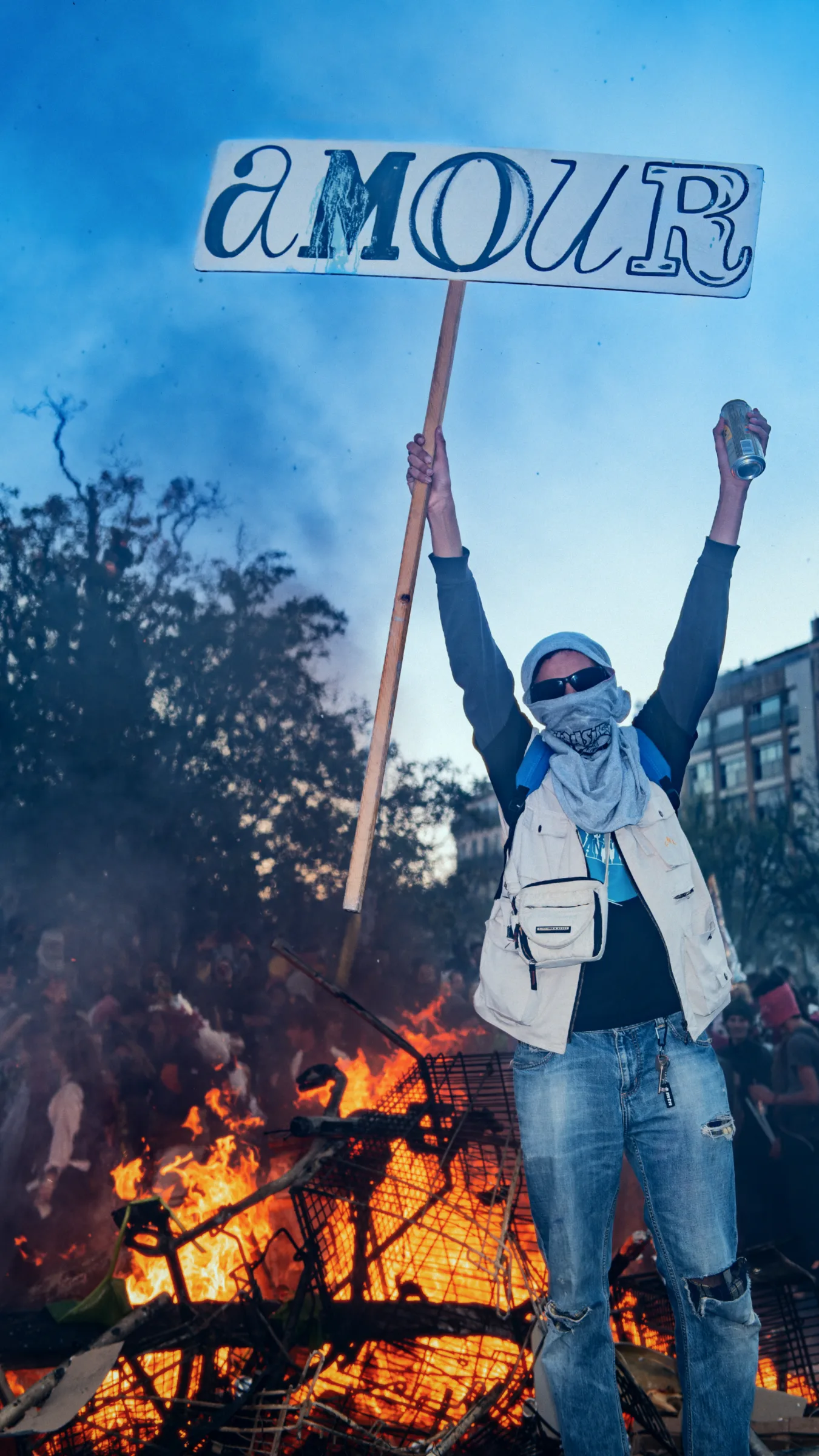
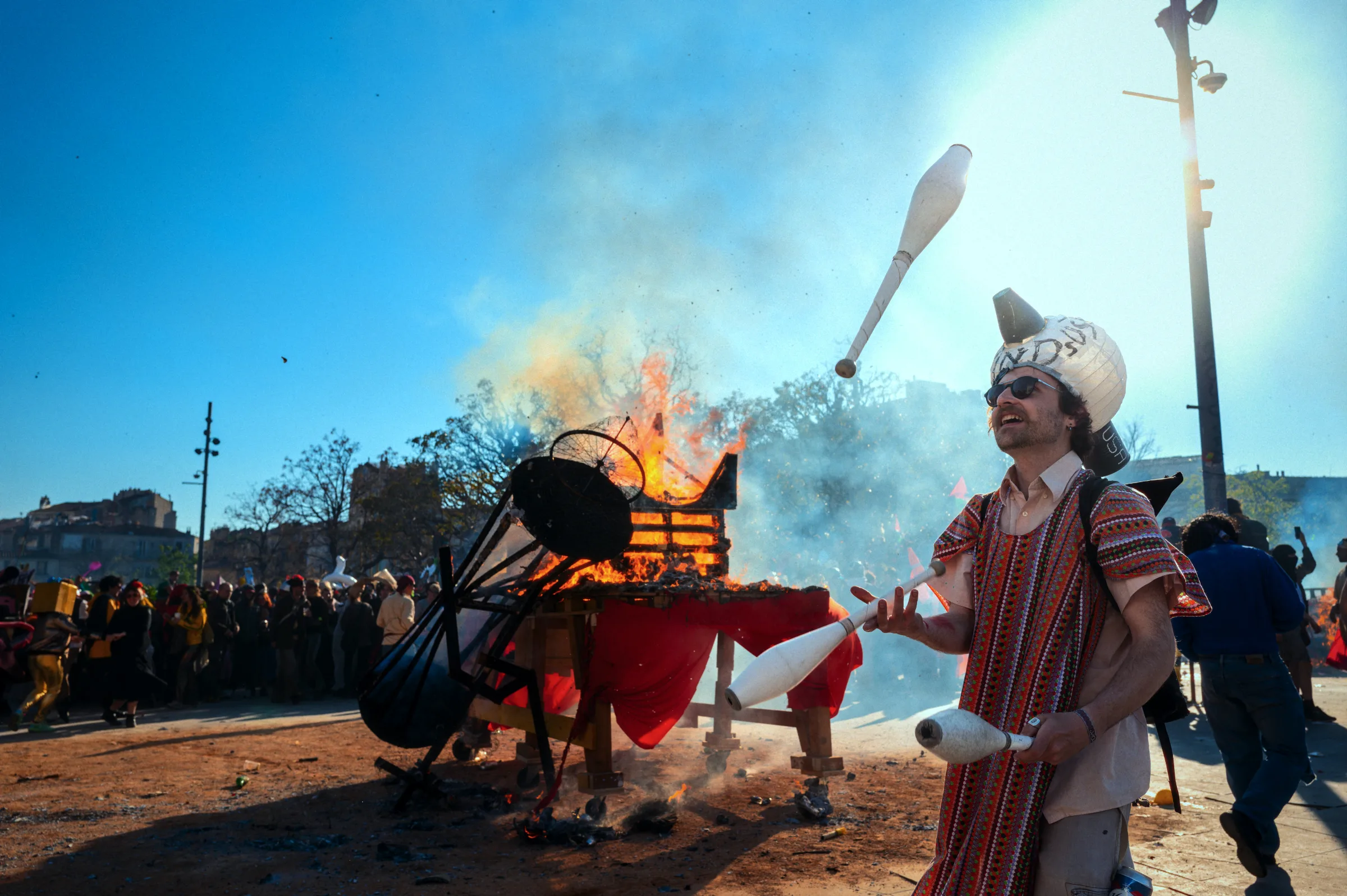
There were 14,000 people on Place Jean-Jaurès, by the authorities' own count. There were floats, brass bands, flour, and a burning Caramantran — the traditional effigy that, each year, embodies the ills of the year gone by. A rallying cry was written across banners: "Balls, not bullets" (Des bals, pas des balles), echoing the wars raging around the world.
Then, at 9 p.m., came the charge.
The 27th Independent Carnival of La Plaine, Noailles, and Réformés took place on Sunday 29 March 2026 in Marseille. Self-organised, run by residents and collectives, never declared to the authorities since its inception, it once again ended in tear gas — and this time, in a criminal investigation for aggravated violence entrusted to France's General Inspectorate of the National Police (IGPN), the country's police watchdog.
A Festival Banned After 7 p.m.
Two days before the carnival, the Bouches-du-Rhône police prefecture issued unusually strict rules. Festivities to end at 7 p.m. A ban on fireworks. A ban on objects that could be used as weapons. A ban on the sale of alcohol to take away, and on glass containers. A ban on private individuals carrying fuel or gas.
Authorities justified these measures by pointing to past editions: damage to street furniture, CCTV cameras targeted, deliberate fires. A "preventive cleanup" of the streets was even arranged with local authorities to remove any object that could be used as a projectile.
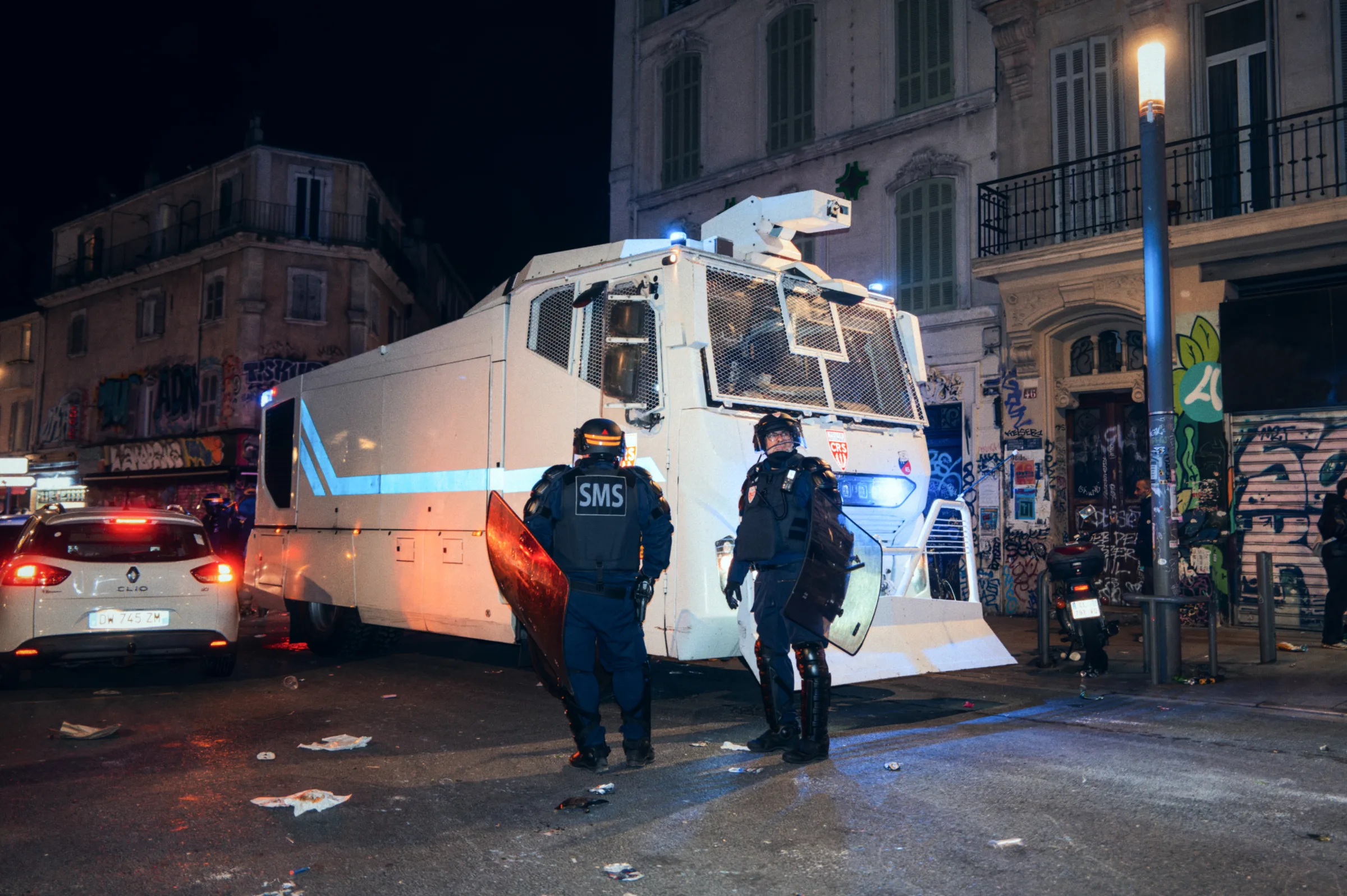
On the ground, hundreds of riot police (CRS), plainclothes anti-crime units (BAC), and regular national police officers were deployed under the authority of Prefect Jacques Witkowski. The exact number was never officially disclosed.
The Day: Parade, Trial, Caramantran
The afternoon unfolded with the grammar of a self-organised carnival. At 2 p.m., the parade set off. At 3 p.m., the "trial" of the Caramantran began — a ritual figure that concentrates the year's frustrations before being burned. Brazilian-style batucada drumlines moved through Noailles. Soapbox carts rolled down La Plaine. The traditional song "Adieu paure Carnaval" accompanied the pyre.
Public sources and available footage describe a "good-natured" atmosphere throughout the afternoon. Yet by late day, fireworks and smoke bombs were being set off on Place Jean-Jaurès, in defiance of the prefectural orders. Alcohol circulated. The 7 p.m. cutoff was not observed.
9 p.m.: The Evacuation
According to the timeline communicated by the police prefecture:
- 9:00 p.m.: police units take position on Place Jean-Jaurès.
- 9:10 p.m.: warnings issued on prefectural instruction. The evacuation manoeuvre begins.
- Around 10:30 p.m.: the dispersal is declared effective.
Authorities describe officers "targeted by projectiles and mortar-style fireworks", who responded with tear gas and a water cannon to restore order.
It is at this precise moment that the narratives split.
Two Official Tallies, Not Quite the Same
On Monday 30 March, the police prefecture released a first tally:
- 7 arrests
- 14 police officers lightly injured
These figures were relayed by France 3, France Bleu, and most local media.
Later that same day, a second, heavier tally appeared. It was carried by the Interior Minister Laurent Nuñez, who published a message of support for the police on X:
"All my support to the 17 police officers lightly injured during the interventions carried out to put an end to the serious incidents on the fringes of the event and restore public order. Targeted by projectiles and mortar fire, they made 13 arrests."
That is 13 arrests and 17 injured officers. Franceinfo, Europe 1, and several national outlets picked up this consolidated figure. According to a police source quoted by Europe 1, six of those arrested were already known to law enforcement.
The gap between the two tallies has never been publicly explained. It is most likely the result of an initial field report being revised upward during the day — but no official reconciliation has been issued.
No official tally of civilian injuries has been published to date.
Rue d'Aubagne: The Other Shock
On Monday morning, residents of the Noailles neighbourhood discovered graffiti on the façade of the memorial site at 65 Rue d'Aubagne. This is where two buildings collapsed on 5 November 2018, killing eight people — a tragedy that continues to shape Marseille's political life.
Marseille's mayor, Benoît Payan, reacted quickly:
"The Rue d'Aubagne memorial is a place of remembrance that must be respected. Eight of our own died there. To damage it is unacceptable."
The City announced it would file a complaint. Former housing deputy Patrick Amico denounced the damage as "vile and foolish". A local resident, Soledad, told France Bleu: "I'm angry and I'm sad. The memorial — the place where we lost our neighbours — I just don't understand."
At this stage, it remains impossible to link this damage to any identified perpetrator, or to say whether it was done during the afternoon parade or in the confusion of the evening dispersal.
2 April: A Complaint
Four days after the carnival, a man filed a complaint at the Noailles police station. His name is Erhan Kaya. According to the account published by Marsactu, he left the station with:
- five days of medically certified work incapacity
- seven stitches across the bridge of his nose
- a psychological trauma he describes as "still raw"
He filed a complaint against unnamed persons for "intentional violence committed by public officials". His lawyer, Valentin Loret, explained the urgency of the filing:
"The point is to secure the CCTV footage. The prosecutor has done what was needed — the question now is whether the footage will be usable."
On 13 April, Marsactu revealed that the Marseille prosecutor had opened an investigation for aggravated violence and referred it to the IGPN — France's police watchdog.
According to the local outlet, seven further statements from carnival-goers claiming to be victims of police violence have been gathered. Additional complaints are reportedly being prepared.
A Growing Body of Testimony
Beyond Erhan Kaya's complaint, carnival-goers' accounts have been gathered and published by the activist collective Marseille 1973, whose name refers to one of the darkest years in Marseille's social and racial history — a summer marked by a wave of racist attacks on immigrant workers.
In a statement posted on Instagram on 30 March 2026, the collective compiled dozens of accounts. These testimonies are anonymous, have not been individually verified by our newsroom, and the overall figures they cite have not been confirmed by any independent source. They are nonetheless worth reading, because they converge on a single picture: an evacuation experienced as brutal and indiscriminate.
Among the published accounts:
"I got tear-gassed while I was dancing around the fire with dozens of other people. Suddenly, gas in the eyes — impossible to see properly, impossible to breathe. We thought we were going to die. We didn't know which way to go, or how to avoid heading into the fire."
Another account describes a scene at the entrance of a street adjacent to Place Jean-Jaurès:
"Tear gas had started to be fired. My friends and I wanted to leave the square and go to my place in the street right behind. Except the street was blocked by a police line (…) One officer refused to let me through, and the other shoved me — and suddenly I took a baton strike to the head. I fell to the ground (…) I have a 1–2 cm gash on my skull."
Another person describes the scene at 9:10 p.m.:
"Several tear-gas grenade pellets hit my shoulder, and a stun grenade exploded right next to my ear, deafening me. There were hundreds of us in the same space when it happened — impossible to hear any police warnings."
Other accounts describe asthma attacks triggered by the gas, a verbal attack described as "racist" on Rue de la Bibliothèque, and tear gas fired "at close range" at small groups as late as 1 a.m. Several witnesses report being treated by firefighters or taken by ambulance, though no consolidated medical tally has ever been released.
In total, the collective claims 33 carnival-goers were injured, including seven to the head, eight by baton blows, one racially motivated assault, and 2,000 people tear-gassed. These figures, which the collective itself describes as a "non-exhaustive count", have not been independently verified, confirmed by any medical source, or acknowledged by any public authority. We cite them as claims made by an activist collective — not as established facts.
What We Still Don't Know
As of this article's publication, several questions remain unanswered:
- The precise procedural status of the IGPN investigation has not been made public.
- No case number has been disclosed — neither for Erhan Kaya's complaint, nor for the City's complaint regarding Rue d'Aubagne.
- The exact number of officers deployed has not been officially stated.
- The public cost of the policing operation and of the repairs has not been released.
- No official medical tally of civilian injuries has been produced — not by emergency services, not by Marseille hospitals, not by the City.
- The official route of the 2026 parade does not appear in any publicly available source we could find.
A written question submitted to the National Assembly on 21 April by MP Gisèle Lelouis revisited the event and its prefectural framing, but brought no new judicial information.
Two Narratives, One Night
On one side, the authorities describe an undeclared carnival, a 7 p.m. cutoff ignored, projectiles aimed at officers, and an evacuation carried out in line with prefectural orders. On the other, public videos, dozens of converging testimonies, and one complaint now in the hands of the police watchdog point to the brutality of the intervention.
The two accounts are not necessarily incompatible. But they do not describe the same night.
For an event that has gathered, for twenty-six years, a slice of popular, self-organised, and political Marseille — and that ends each year in a confrontation with the police — the open question is no longer whether violence took place. It is who bears responsibility for it, and how far the judicial system will go to find out.
The IGPN investigation has only just begun.
Main Sources
- Marsactu — Investigation opened into police violence during the Carnaval de la Plaine
- Franceinfo — Seventeen police officers injured in Marseille during clashes
- France 3 Provence-Alpes-Côte d'Azur — Seven arrests, lightly injured, and "unacceptable damage"
- France Bleu Provence — The Rue d'Aubagne memorial vandalised
- Maritima — Carnaval de la Plaine 2026 placed under heavy police supervision
- Europe 1 — Partially banned, the Carnaval de la Plaine turns to clashes with police
- Marseille 1973 collective — Instagram statement of 30 March 2026 (anonymous testimonies; figures not independently verified)
This article will be updated as the IGPN investigation develops.


